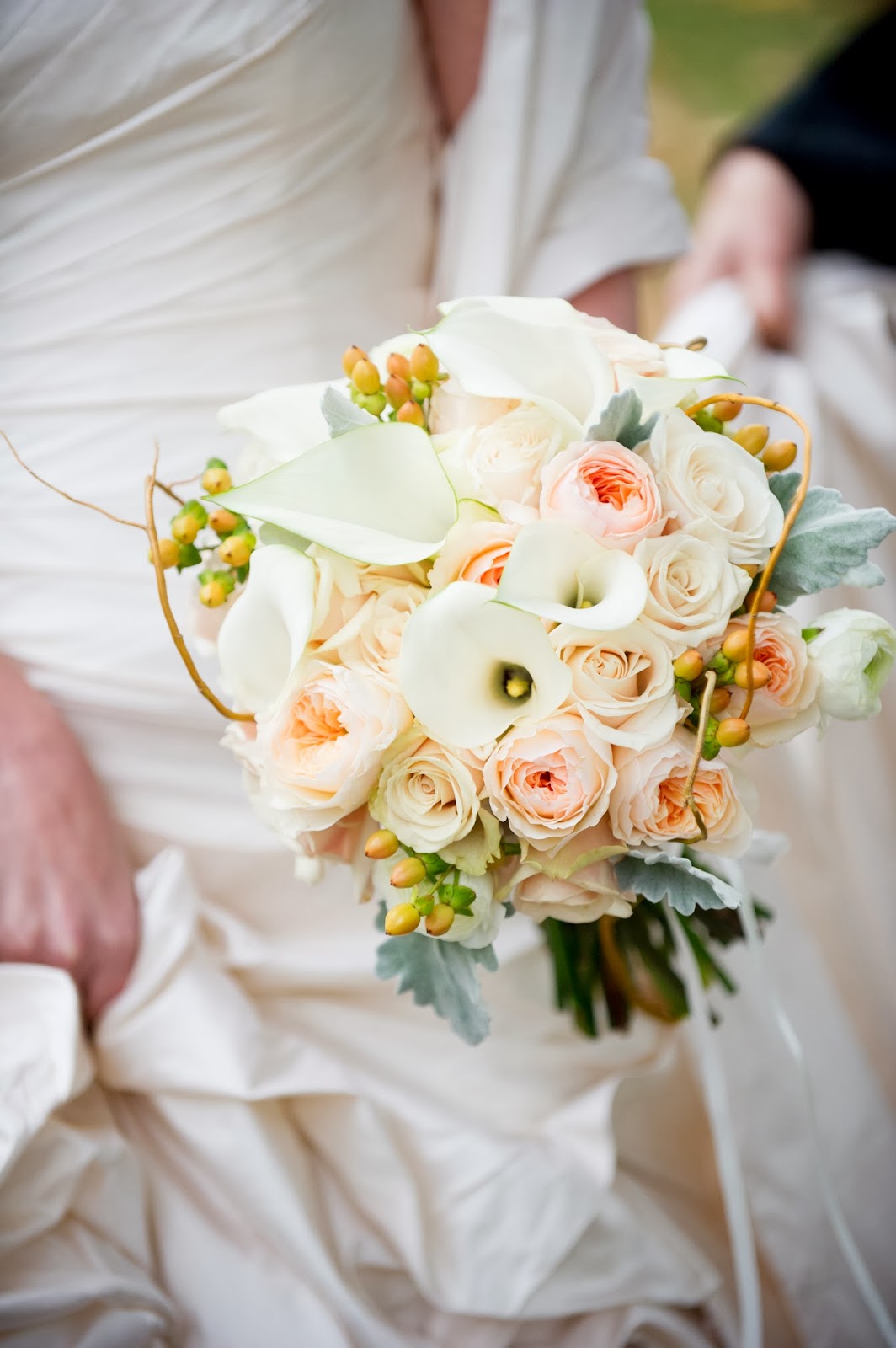
Tuesday, January 13, 2015
Ceremony vases at Elm Bank
Elm Bank, home of the New England Horticultural Society, was the magical setting of Aaron and Sophie's wedding late last summer. They were married atop marble steps overlooking a formal Italianate garden.
Monday, January 12, 2015
Romantic in Red
Red has so many connotations. I am reminded of the passion of Scarlet O'Hara, who tears rich red velvet drapes from the windows of a half-burned Tara, to make herself a new ballgown... Morgan and Jon chose a limited but dynamic palette for their October 2014 wedding at Fruitlands Museum in Harvard. Within their color scheme we found so many reds - from deep to bright, from pure to dappled. The variety was dazzling: roses, orchids, dahlias, anemone, pin cushion protea, sunset protea, and autumn foliage -- all presented themselves. Oh the romance of reds!
Saturday, January 3, 2015
Intimate Autumn Wedding at the Herb Lyceum in Groton
Just today, a bride sent me a couple of images from her October wedding. What a pleasure to see the bright sweet colors of autumn and to remember the lovely flurry that attended her wedding, a small gathering of family and friends, at the beautiful Herb Lyceum in Groton, MA. We had worked together rather intensely for a few short weeks, Becky flying in from Los Angeles for a couple of quick visits, but she knew what she wanted -- bright pinks, oranges, and purples, along with peach tones, whites, and complementary silvery greens in a lush, naturalistic gathering. Knowing her affinity for smaller flowers, we decided on anemones, ranunculus, spray roses, white lisianthus, and for the soft grey-greens -- dusty miller, and succulents.
Some weddings seem to fall into place without quite so much time and planning -- in part due to size and venue -- Cathy Gilson at the Herb Lyceum helps couples choose fresh, local, seasonal (richly flavored and stunningly presented) dishes, a natural for the Lyceum which serves exquisite dinners every weekend of the year. The garden (with small waterfall, perennial borders, lavender beds, wrought iron furniture, rustic antique statuary, stone terrace, and majestic old trees) -- provides a graceful backdrop. I always think of the modest Tuscan farmhouse we stopped at once, as part of a self-designed agri-tourism excursion, for a beautiful meal. Perhaps it's that association with the convincing illusion of ease in the air, that makes me think the whole tableau at the Lyceum, including the flower designs we've worked on for the last day or two or three, have simply fallen, full formed from the beneficent sky. Wednesday, February 5, 2014
Love on a hilltop - Subtle, chic, and oh so eloquent
![]() |
| Photos by Michael Charles |
For the bouquets, Jennifer chose the Sahara, a sandy colored rose with hints of coffee and cream (The Sahara is one of those rare roses that ages beautifully.). And for the centerpieces, Peegee hydrangea, which comes into its own in autumn in New England, along with off white and green hydrangea, peach hypericum berries, and the vanilla Vendella rose.
To the raised centerpieces we added green hanging amaranth - with its vintage style drape...

I have to say this was a chic wedding - in a setting that's impossible to rival. But had these two chosen to marry in downtown Boston, their choice of flowers and designs, subtle and timeless, would have been equally vocal in expressing their enviable sense of style and profound happiness.
Tuesday, February 4, 2014
Style: Reinventing the Classical
![]() |
| Photos by Scott Zuehlke |
![]() |
| Photo by Joe Ofria |
The reception took place at the classical and lovely Nashawtuc Country Club in Concord.
Thursday, March 17, 2011
To be or not to be... organized
![]() |
| Red callas with orchids |
Sunday, December 5, 2010
Last-Minute Bouquet
Kristin was far from the first bride to change her mind about her flower choices, only the timing made the switch a bit more dramatic. We had worked together over many months and across more miles - she was living and working in Houston while I'm generally found at home in Groton. We met only once, on a rainy April morning at the Taj Hotel in Boston, where she and her fiance would be married the following August. Through the course of innumerable emails and telephone conversations, Kristin remained certain she wanted an all white and ivory bouquet of mini callas and cymbidium orchids for herself, while her bridesmaids, wearing rich burgundy silk dresses, would carry more colorful posies. Less than two weeks before her wedding - her blooms already on order at the Boston Flower Exchange - Kristin decided she wanted a rich compote of color to match the rest of her wedding flowers. We came up with a bouquet of callas - eggplant, pink, and Picasso (a sensual mix of cream and purple), green cymbidium orchids, and lavender lisianthus. For her bridesmaids' bouquets, we added deep pink dendrobium orchids to purple lisianthus and Picasso callas. Nervous about the last-minute nature of things, I changed the flower order (Sometime I want to write about the hidden heroes of these occasions - the flower vendors at the market, so accommodating and informative) and the day before her wedding put everything together. It worked, to everyone's delight. To me, Kristin's bouquet proves flowers reign supreme as the expression of an occasion whose meaning defies logic, definition, and easy choices.
Sunday, March 14, 2010
Promiscuous Assemblage - Flowers, shells, insects, and artwork
Living amongst such a collection must have been a feat. It is difficult to imagine how Soane's wife, two sons, servants, and pets, not to mention guests, managed to reach across the breakfast table, let alone change their clothes. For Soane was an inveterate collector, like so many educated people of wealth and prominence in the 18th and 19th centuries when, as Kipling wrote, "The sun never set on the British Empire." Vast the scope, and utterly without scruples the reach of archeologists, scholars, and amateur enthusiasts alike who plundered Greece, Rome, and Egypt for relics. The Elgin Marbles at the British Museum are a perfect example. Thus, Sir John Soane's home is itself a "promiscuous assemblage," as the Duchess of Portland's famous museum collection was called, of Greek and Roman terracotta, Medieval objects, artwork by Hogarth, Reynolds, Canaletto, and others, as well as classical and Egyptian antiquities, to summarize briefly. Among Soane's many possessions is a dazzling signet ring belonging to Napoleon Bonaparte, whom he much admired.
But Mary Delany's work is the subject here. She had a passion for natural history (Linnaean's system of categorizing plant and animal species had just come into vogue) and the decorative arts, a love of flowers, shells, and china -- shared by her friend the Duchess of Portland. Her botanical collages made from tiny bits of painted paper, are only a part of this exhibition, but they reveal her extraordinary eye and hand, as well as her vast knowledge of botany. So do her journals of plant illustrations, her embroidery - more flowers exquisitely stitched on large panels of black velvet. The exhibition includes her intimate oil portraits and landscapes. Clearly, Delany was a cultivated woman of genius, character, and rare accomplishment, equipped with a gift for friendships, too. Much of her shell collection, also on display at the Soane Museum, belonged to the Portland Museum, whose contents was auctioned off in April 1786. The cabinets of tiny drawers filled with shells will delight the miniaturist. Indeed, like the 21st-century Maine artist, Brian White, whose shell-flower-embellished wedding dresses have appeared at the Peabody Essex Museum and the Portland Museum of Art, Delany spent her spare hours making shell flowers to cover a chapel ceiling and a chandelier.
The Sir John Soane Museum offers an intimate glimpse of minds drawn to the world of beauty in art and nature. If you find yourself in London, take in this amazing show.
Monday, March 8, 2010
Transcendental Blooms
The setting: A rural venue with a Transcendental - Shaker - American Indian legacy. A red farmhouse of simple antique Colonial rooms has been turned into the Alcott Restaurant and Tea Room. Sunlight brings delicious notes of spring through the old windows, and beyond – a stunning view over the Nashoba River Valley to Mount Monadnock, a view that resonates with at least four centuries of recorded history, a view that drew Bronson Alcott and other aspirants to this very spot in 1843, when the Transcendentalists set up their (alas, short-lived) Utopian experiment known as Fruitlands.
The flowers must be romantic, rustic, elegant, pretty. It's a treat to rely on whim and inspiration at the flower market. This is seldom possible in the busy wedding season when I order blooms ahead for arrangements long discussed and visualized. A rare opportunity, a time to learn new things. And I do. I discover a new (to me) dendrobium orchid with slender twisting petals in a subtle pink and white stripe. It looks far more exotic than the usual rounded-petaled dendrobium, and is irresistible. My only rationale - compared to Marie Antoinette's extravagances, this is tiddly winks.
Soon the car is filled with brown paper sleeves of creamy freesia, blue delphinium, burgundy ranunculus, purple genestra, white and purple stock, pink dendrobium orchids, seeded eucalyptus, steel grass, white lisianthus, sweet pea of a dangerous pink, pussy willow, and curly willow. More than I need? Invariably. And yet it always turns out every stem finds a place, and I couldn’t have done with less.
Here are two arrangements I came up with for the open house – a long-and-low for the reception table; it has a traditional look, except for a few details - steel grass cut short in a sort of Japanese-like fan, and an asymmetry that gives it new life, and a cocktail vase of those new dendrobium orchids.
Thursday, February 25, 2010
Simple flowers adorn the moment in an ancient stone chapel
The ceremony took place in a tiny 13th century chapel… tiny and yet, like the proverbial Volkswagen Beetle out of which dance a dozen circus clowns, some 90 guests find comfort and peace on wooden pews inside the ancient stone walls. Little décor is needed in such a setting. Rather the gift of a sensitive hand and eye – a long-and-low arrangement of miniature yellow daffodils with moss and ivy sits on a window ledge in the apse. So natural, so pure; these flowers possess all the virtues of simplicity. The designer has clearly drawn on the promise of spring to sanctify and adorn the moment.
In London neighborhoods dense with boutiques and restaurants the predominant colors are gray and white interrupted by green parks and peaceful squares. Yet wee occasionally spy a flower stall (reminiscent of Eliza Doolittle in My Fair Lady?) nestled against a church wall, filled with sheaths of bright blooming lilies, roses, and the like, along with piquant bouquets set into niches in the stone facade. No one is minding the stall; perhaps the flower seller has nipped into the next door cafe for a cappuccino; and we all remark on these blooms that offer such delight to passersby.
And now I must admit we lost our digital camera at the British Museum, and all the shots of flowers in the museum and on the street vanished with it.
Tuesday, September 8, 2009
Dahlias Open the Mind's Eye
For dahlia lovers everywhere and in particular for anyone planning late summer nuptials on the east coast, this engaging and informative article in September’s Down East Magazine about Endless Summer Flower Farm in Camden, Maine, will spark keen interest. Even if you never gave dahlias more than a half glance before now, writer Rebecca Martin Evarts’s descriptions of dahlias, with their ancient Aztec origins (as a wanton weed) and saucy contemporary presence will surely enchant and tempt. Here’s a glimpse into dahlia Eden, the lovely people who make it happen year after year, and the surest and best source of fresh, local dahlias Down East.
I first met the
And then, the way the
Tuesday, April 21, 2009
Art in Bloom and Sensibilities Aflame
The day is nearly upon us. Art in Bloom comes to the MFA this weekend. It starts early Friday morning when designers are given free parking and approximately three hours to put together their arrangements throughout the museum exhibition halls and byways. They will bring vases, blooms, stones, moss, grasses, ferns, leaves, twigs, and branches. They will spread drop cloths under their vases, and set to work rapidly -- composure mingled with suspense -- using scissors, knives, watering jugs, and their hands to turn what may look like a grab bag of random organic things into coherent, imaginative designs that complement the artwork and spaces.
We're talking ephemeral public art, here. It may not last more than a few days, but as surely as the paintings, sculptures, and decorative furnishings bring visual pleasure to all gallery goers, this burst of fresh color, texture, and inspired design will nourish the souls of passers by and offer a sense of hope and joie de vivre -- all the sharper, perhaps, for the accompanying awareness that flowers fade and a wind ruffles the wild grasses in fields and meadow.
It will be a lavish display for sure, and some may decry the expense in hard times. But "reason not the need" as Shakespeare said, and enjoy the riches of a precious moment.
Ambivalence - Hands-on or hands off flower design?
In the five years since I started Flourish, brides have repeatedly told me (with a mixture of shock and awe in their voices) my prices are reasonable. I didn't mean it that way! I am working for a living, after all. But it seems most flower designers simply charge a lot more. There are good reasons, too, that go beyond the price of blooms. A lot of time, thought, and mileage go into flower shopping, preparation, design, delivery and setup. Add to that the notion that the wedding industry seemed to be on an endlessly spiraling stairway to heaven - not so many years ago, The New York Times reported that the average wedding cost well over $100,000 - and of course it made sense to ride on up the escalator.
When I price out a wedding flower proposal (with everything itemized so a couple can see where their money goes and pick and choose how they want to spend it), I make sure I feel amply rewarded for my work. At the same time, I like to think couples may be getting a (slight) benefit (because I know how the cost goes zinging up for no apparent reason) and with luck having a good time. I know their day will be beautiful, full of fresh flowers imaginatively designed, that the service I offer is uniquely personal and impeccable, and that at the end of that glorious day, they will be well-pleased.
So, yes, I write with a divided heart. Of course I want to democratize the world of flower design. Of courses it's great brides and their friends are learning to shop for flowers, prep, and design them. I'm happy people are applying their hands and brains to this ancient art. What could be more satisfying than designing the flowers for your wedding day? At the same time, I'm feeling a thread of trepidation, and a degree of pride and what to call it? Snobbery? Ownership? It has taken me quite a few years to gain the skills of this particular trade, and I'm still learning. Successful flower design takes time and trial - flowers are high maintenance creatures: fickle, fussy, and fragile. You have to treat them with care, and learn their ways. If a bride can do that, as well as tend to all the details of her day, terrific! If not, please, I'd love to help you out!
Friday, February 20, 2009
Thinking Ahead to Art in Bloom at the MFA

(Flowers by the MFA staff on a Friday in January.)
Here's the assignment: Design a knockout vase arrangement -- one, two, or three -- to suit the new Sharf Visitor Center at the Boston Museum of Fine Arts. What's the occasion? The MFA's Art in Bloom weekend, April 24 to 26, 2009. The space is long, low, and sleek. The colors off whites and greys. The lines boxy and sleek - sans clutter and surface decor, with the addition of massive circular columns behind and in front of the information desk.
Should the design follow the spare, linear qualities of the space, or break out with an organic burst of cherry blossoms, say, or magnolia? Should the vase itself be dark like the ones pictured above, and have intrinsic drama, or should it seem to disappear? Those child-sized vases in John Singer Sargent's painting The Daughters of Edward Darley Boit (1882) came to mind. Would something Asian and ornate add a delicious counterpoint to the clean lines of this 21st century design? It might, but practicality argues against. A tall clear glass cylinder, on the other hand, reasonably priced and elegant, would echo the columns. If filled with river rock, with flower petals scattered against the glass, it might harmonize with the ambiance, and stir thoughts of a peaceful garden.
Perhaps it comes down simply to what does the eye crave and the soul want from flowers? How to make a lasting statement in a space that argues against fuss? Or is that just what's needed? An architect I know says, yes, bring on the color and the intricacy. As yet, I have no solutions, only a vision slowly taking shape.
Saturday, January 17, 2009
Learning to Love Glads
I hate to say it but gladiolas just did not cut it with me until recently. They reminded me of funerals – not that there’s anything intrinsically wrong with such occasions; we’ll all have one – but they cast a slur on gladiolas which made the flower seem dower and unapproachable. Such a long term association comes from my childhood exposure to glads (as my mother called them), when in dusty salmon or dirty white, only, they were to be seen lolling about in the background of the florists’ display windows on Madison Avenue, hovering like an uninvited guest.
But recently, my heart turned a corner with respect to gladiolas. I started to notice their dazzling colors (and sometimes duotones) at the Boston Flower Exchange. . No other flower outside of the rose comes in as many shades and hues: from soft mauve and scarlet to rust and claret to pale pink to dark pink to a pink-fringed white, to juicy orange, lemon, and lime. Clear, vivid, and seductive Given their palette and glorious stature, I started using gladiolas in designs destined for anything but a funeral parlor.
No longer merely the foil for other flowers, the gladiola is a stunner in its own right. You can use individual blossoms in low centerpieces, boutonnières, or corsages, or cut the stalks shorter to give the gladiolas more heft and presence in a contemporary glass or ceramic vase. A tall vase filled with gladiolas can look downright contemporary.
What changed my mind? A with-it young woman from
So now I have a different take on that quintessentially 1950s flower. Let me tell you why: They have drama, they have scale; they have longevity and affordability on their side. Two dozen glads fanning out horizontally and in an upward spread can transform a space.
Thursday, July 3, 2008
Nesmith House in Lowell - An Historic and Intimate Venue

I visited the historic, 22-room Nesmith House in Lowell for the first time this spring. What a splendid place it is. Like all old homes, it has its stories, and an irresistible sense of romance and mystery.
This Greek Revival 1850’s mansion sits atop a hill in the Bellevidere district overlooking downtown Lowell and the Lowell Mills. What more fitting vista for its original owner, the industrialist and politically engaged John Nesmith.
What will bring me back for a second look? – Oh, the sheer pleasure of stepping across the threshold into another age. And a happy feeling about the place. The staff at Nesmith House appear to love this glorious building, the caterers that day, Two Chefs Are Better Than One, seemed at home, and the house, owned and used for visitors’ accommodations (it has some 11 bedrooms) by Middlesex Community College Foundation, had the well-kept feeling of a living museum.
Tuesday, April 29, 2008
Spring Beauties

Friday, February 1, 2008
Seeing Red - Flowers of Late Winter
For bold statements, it’s good to think mono-floral in February, to consider amaryllis, gerbera daisies, orchids, lilies, and less expensive gladiolas and tulips. Roses, of course, are always with us, particularly as Valentine’s Day approaches. But miracle of miracles, while the world is still swathed in white, or bringing sleet and high winds, tulips, pussy willows, daffodils, and pale pink quince blossoms are making their first appearance at the Boston Flower Exchange.
Just today, I watched a sheaf of red hypericum berries, silvery green seeded eucalyptus, and pinky brown pepper berries being wrapped and readied for a foray out into the cold.
Yes, the season has definitely turned away from the reds and greens and whites of December, and yet Valentine’s Day presses upon us. I urge you to consider flowers other than red roses, whose price zings up with the demand. A bunch of red tulips even – who can resist their sleek heads? (Cut them extra short to start with, as the tulip, like one's nose, keeps growing. ) Delphinium in seriously delicious shades of blue (from pale to midnight) are regal and long lasting. There are two kinds to consider, the hybrid with their dense flowers, and the Belladona delphs with their dancing airier blooms. The former really can stand alone; the latter goes well with pussy willow, or green amaranthus spilling over the side of the vase. Or consider lime green cymbidium orchids in a low square Asian vase, with jade roses. Now there's a Valentine vase your beloved will remember.
Wednesday, January 16, 2008
Pass the (organic) roses please


If you’ve caught scent of the happy fusion of flowers and food lately, in restaurants, upscale markets, and organic farm stands, you are clearly on the path to all that’s current, chic, and aesthetically pleasing about the food revolution. Flowers have regained their place at table, and I don't mean as centerpieces to admire, but as integral ingredients in soups, rice and pasta dishes, salads, omelets, and desserts. Petals not only look pretty, they taste good – crunchy, peppery, sweet, fresh, redolent of field and forest.
In truth, food and flowers have long kept company. Only, now, as the boundaries blur between so many things formerly thought opposing (fiction and nonfiction for example), imaginative chefs and organic gardeners unite old world practices with new world taste buds and aesthetics to bring flowers to meals in novel ways. (Yes, flowers as decorative and tasty curatives have been around forever. Indeed, there are certain ancient cures we may not care to try. Who will rise to the challenge of a 16th-century cure for insanity involving daisies steeped in wine with sage and southernwood, for example?)
Chosen well -- use organic only, please! and when added to simple dishes that will not overwhelm their delicacy, flower petals bring elegance, color, flavor, texture, wit, and famed curative powers to many a dish.
Try It
We’ve all put nasturtium leaves (for their peppery flavor) and flowers (for their vibrant red-orange-yellow dash of color) in salads, but what about rose or peony petals, violets, violas, and gladiolas tossed between the radicchio and endive? Or tulip petals with the crunch of cucumbers? Or tender white sweet pea blossoms? Apple blossoms (in moderation, please, they are cyanide precursors ) add flavor to fruit compotes, as do garlic flowers to salad dressing, marigold petals (known as Poor Man’s Saffron) to soups, pasta, rice dishes, herb butters, and salads. Carnation petals steeped in wine or other drinks add a faint sweetness and are said to be calming, chrysanthemum petals have a slight peppery taste, bee balm tastes like oregano, and daylilies (cut away from the bitter white base) make marvelous desserts, I hear.
In Mexico, hibiscus flowers are used in jamaico, a cool drink infusion, as well for making ice cream and sorbet. In Asia and North Africa, a cup of mint or jasmine tea may reach your hand afloat with orange blossoms. In Asia, too, daylilies find their way into salads and hot and sour soup.
Five marigold petals floating in a bowl of pale green spinach soup, just seems timeless, does it not? Like goldfish in a Zen water garden.
Sunday, January 6, 2008
The Peony Plays Hard to Get

Common Name: Peony
Botanical Name: Paeonia
A few weeks ago, I was aghast to see peonies beside the amaryllis and snow berry at the Boston Flower Exchange. Irony of ironies! The one flower in the Chinese Empress’s palace garden that refused to bloom on command one winter night, and honored forever by the Chinese for its unyielding nature; that very peony or its South American cousin suddenly available year round? Go see for yourself.
Growers across the country have caught the peony fever. “We’re just mad about peonies,” writes Kasha Furman, owner of Cricket Hill Garden, in Thomaston, CT. Other cultivators from New Hampshire to Washington State sound equally enthralled.
Several years ago, I was booked to design flowers for a late June wedding. The bride, just out of law school, wanted among other flowers, pale pink peonies. I cheered her on. But when three weeks before her wedding, she opted for the more vibrant and dashing burgundy peony, I started to quake. A promise-her-anything-but give-her-Arpege tactic kicked in. But of course, I said, and suffered several sleepless nights full of courtroom dramas related to flowers.
None of the vendors at the Boston Flower Exchange could promise dark peonies for June 25. Local gardeners said the same thing. Everything depends on the weather. A cool June would keep the peonies blooming; a hot month would hasten their demise. The days were heating up, and so was my anxiety.
The pedigree of a classical beauty:
Peonies are among the oldest plants cultivated for their flowers and the healing properties of their tuberous roots and shiny dark seeds. In China, where records mentioning peonies date back to 600 B.C., it was known as "the King of Flowers," and often portrayed with the phoenix, a symbol of life arising triumphant from the ashes. The genus includes about 30 species, but the two chief divisions are the herbaceous peonies, those soft-stemmed plants that die back in winter, and "tree" peonies, shrubs that have a persistent woody framework.
Known and valued in Europe since the middle ages, the heavy-headed lush lactiflora hybrid peony first appeared in America on the cut flower market in 1884. Beginning in the 1920s the chemist A.P. Saunders, started on his thirty-year quest to develop a hybrid peony by crossing the Chinese peony (lactiflora) with the European P. officinalis. He succeeded.
Working in his lab in Clinton, NY, Saunders created a lighter-headed peony that flourished in the garden, where the old world top heavy peony had a habit of falling on its face. Among Saunders’s hybrids are Athena, a creamy pink centered flower, White Innocence, a tall late-blooming single, Echo, a pale single-petal lavender, and the burgundy Early Bird.
· Cricket Hill Garden, in Thomaston, CT (1-860-283-1042
· Maple Ridge Peony Farm in Conway, MA 01341.